


The Vow of Poverty Nobody Took (2 of 5)
Updated: Jul 13
You didn’t choose scarcity. But somewhere along the way, you married it.
Founder, Merkaba Temple & Merkaba Retreats
Co-Founder, ArcherShaw
Nobody wakes up one day and decides to be afraid of money. Nobody sits down and consciously resolves that abundance is dangerous, that wanting more is shameful, that charging for their gifts is a betrayal of everything sacred.
It happens slower than that. Quieter. It happens in the accumulation of small moments — a parent’s anxiety at the kitchen table, a sermon about the dangers of wealth, a teacher who modeled self-sacrifice as the highest virtue, a community that equated simplicity with holiness and desire with ego.
By the time you are an adult seeking spiritual truth, the vow is already in place. You just never signed it.
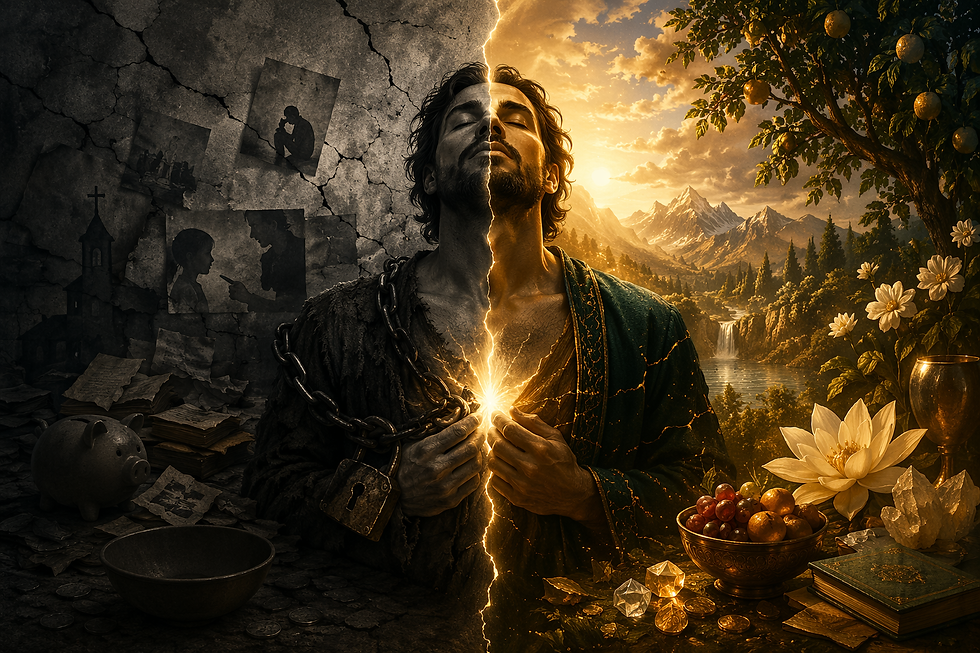
Where It Begins
For many of us, the original transmission about money came from religion. Not as explicit doctrine necessarily — though sometimes it was that too — but as atmosphere. As the unspoken emotional weather of the faith community we grew up inside.
In Protestant Christianity, where many of us began, there was a persistent undercurrent: money is worldly. The truly devoted person holds it lightly, gives generously, and does not accumulate. The rich young ruler walked away sad. The love of money is the root of all evil. These verses landed in young nervous systems not as nuanced theology but as visceral warning: wanting is dangerous. Having too much means you have failed spiritually.
Islam carries its own complex relationship — zakat as obligation, but also deep suspicion of ostentation. Buddhism’s renunciate ideal filtered through western convert culture often became simple equation: less stuff, more enlightened. Even the new age world, which speaks loudly about abundance, carries a shadow — the teacher who charges too much becomes immediately suspect, their spirituality questioned, their motives impure.
These messages compound. They layer. And eventually they stop being messages and become identity.
The Clinical Picture
In my work as a therapist, I have sat with this wound in hundreds of forms.
The healer who has been practicing for fifteen years and still charges what she charged in year two — not because she lacks confidence in her work, but because some part of her believes that wanting more makes her less holy.
The spiritual teacher who gives and gives and gives until he collapses — and calls it devotion, when the clinical picture looks more like a trauma response to his own needs.
The seeker who invests in every course, every modality, every certification — except the one that would actually require real financial commitment. Because real commitment would mean really believing he deserves transformation.
These are not character flaws. They are adaptations. Intelligent, protective responses to environments that taught, implicitly or explicitly, that scarcity was safety. That smallness was virtue. That need itself was a problem to be managed rather than a signal to be honored.
In clinical language we might call this a scarcity schema — a deeply held cognitive and somatic pattern organized around the belief that there is not enough, that I am not enough, and that wanting more is either dangerous or shameful. It is often comorbid with people-pleasing, with difficulty receiving, with the compulsive giving that is really self-erasure in disguise.
It is also, in my experience, one of the most spiritually dressed wounds I encounter. Because it found a home in the language of the sacred, it is extraordinarily difficult to examine. To question it feels like questioning your faith, your values, your very identity as a spiritual person.
The Identity Lock
This is the cruelest part of the vow nobody took.
At some point, scarcity stops being a wound and becomes a self-concept. I am someone who lives simply. I am not attached to money. I am not like those people who chase wealth. The poverty — material or psychological — becomes a badge. A marker of who you are and who you are not.
And identity, once formed, protects itself.
This is why information alone does not shift it. You can read every abundance book, do every visualization, understand intellectually that money is neutral energy — and still find yourself unable to charge what you are worth, unable to invest in what you need, unable to receive when someone offers.
Because the block is not cognitive. It is somatic. It lives in the body, in the nervous system, in the part of you that learned long ago that having more meant something was wrong with you.
The Sufi tradition speaks of nafs — the layers of the ego-self that must be purified on the path. One of the subtler nafs is the one that has convinced itself it is already surrendered. Already unattached. Already beyond the concerns of the material world — while quietly using that very belief to avoid the terror of actually wanting something and not getting it.
Real non-attachment is not poverty consciousness. Real non-attachment is the capacity to hold abundance without being consumed by it. To give freely from fullness. To receive without guilt. To let the flow move in both directions without clutching or refusing.
That is a very different thing from a vow nobody consciously took but almost everyone is living.
Breaking a Vow You Never Made
The work of dissolving a scarcity identity is not primarily financial. It is spiritual and psychological — and it requires the same honesty we bring to any other form of shadow work.
It begins with tracing the lineage. Where did this come from? What did money mean in the home you grew up in? What did your tradition teach you, explicitly and implicitly, about wealth and worth and wanting? Whose voice is speaking when you tell yourself you don’t need more?
It continues with the body. Where does scarcity live in you somatically? What happens in your chest when someone names a price that feels like too much? What happens when someone offers you something generous — can you receive it cleanly, or does something tighten?
And it requires, ultimately, a theological revision. Not an abandonment of your values — but a genuine examination of whether the theology you inherited actually reflects the sacred reality you have come to know.
Because the Shakti does not withhold. The spanda — the divine pulse at the heart of existence — is not a scarcity economy. Creation itself is an act of overflowing abundance, Shiva pouring himself into form not from lack but from the sheer exuberance of being.
You were made from that. You were made as that.
The vow of poverty you never took — you can put it down.

Comments