


Lakshmi Is Not Optional (3 of 5)
Updated: Jul 13
Founder, Merkaba Temple & Merkaba Retreats
Co-Founder, ArcherShaw
You cannot have Shiva without Shakti. You cannot have consciousness without energy. You cannot have the sacred without the material. This is not a metaphor. This is the structure of reality.
In the tantric worldview, there is no division between spirit and matter. No hierarchy in which the invisible is holy and the visible is suspect. No ladder on which you climb away from the world toward God.
There is only Shiva and Shakti. Consciousness and energy. The still witness and the dynamic flow of manifestation. And they are not two things. They are one reality, pulsing between stillness and expression, between the unmanifest and the world you are sitting in right now.
Lakshmi is Shakti in her form as abundance, prosperity, and the flowing grace of a life unobstructed. She is not a goddess you pray to for a new car. She is not the patron saint of the prosperity gospel. She is something far more fundamental — she is the principle that life, when it is aligned with its own deepest nature, flows. Grows. Generates. Overflows.
To reject abundance is not to reject materialism. It is to reject Shakti herself.
The Goddess They Didn’t Teach You
In the tantric texts, Lakshmi is inseparable from Vishnu — the sustaining force of the universe. Where Vishnu holds the cosmic order, Lakshmi is the grace that makes that order fertile. Without her, the cosmos is sustained but barren. With her, it teems.
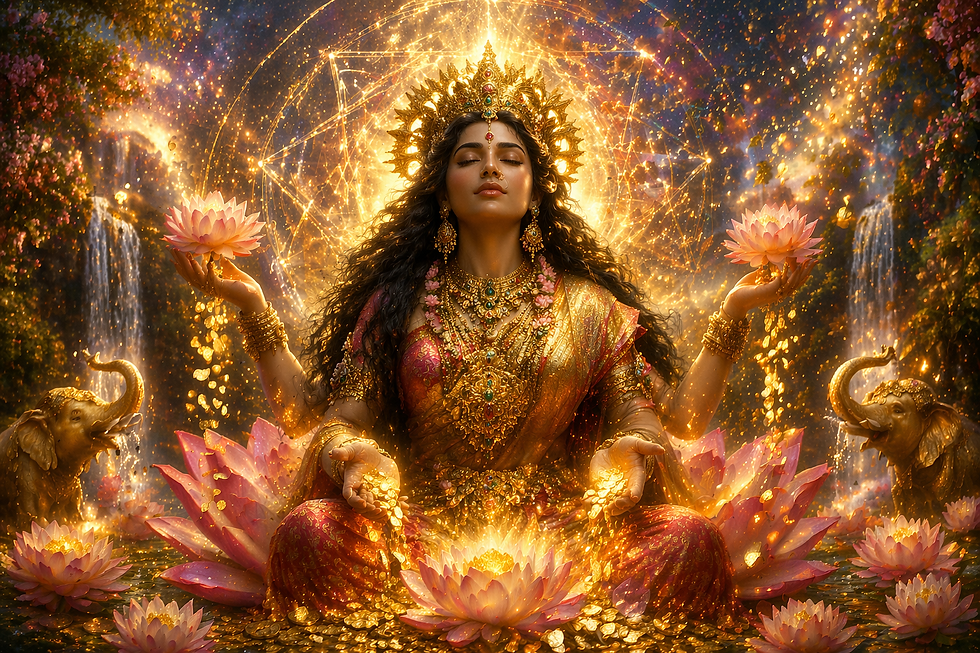
She is depicted seated on a lotus — the flower that grows from mud, that rises through murky water, that blooms in full beauty without being contaminated by what it grew through. This is not accidental iconography. The lotus is the teaching. Abundance does not require a pure or perfect or untroubled origin. It requires the capacity to rise through what is difficult and bloom anyway.
She holds gold coins pouring from her hand — not hoarded, not clutched, but flowing. This is the central image. Lakshmi is not a goddess of accumulation. She is a goddess of flow. The coins pour because that is the nature of abundance when it is healthy — it moves. It circulates. It gives and receives in continuous rhythm.
When flow stops — when we clutch, when we refuse to receive, when we decide that money is beneath us or that wanting is shameful — we are not expressing non-attachment. We are blocking Shakti. We are, in the most literal tantric sense, working against the nature of reality.
Auspiciousness as Spiritual Practice
The Sanskrit word most associated with Lakshmi is shri — often translated as auspiciousness, beauty, or radiant prosperity. It appears before names as a title of reverence. It is the quality of a life that is aligned, flourishing, blessed.
Shri is not wealth in the modern capitalist sense. It is something older and more holistic — the condition of a life in which the material and the spiritual are not at war with each other. In which the body is fed, the spirit is nourished, the relationships are alive, the work is meaningful, and the exchange with the world is healthy.
This is what Lakshmi represents. Not richness as dominance. Not wealth as proof of God’s favor. But shri — the radiant condition of an unobstructed life.
The tantric path takes the cultivation of shri seriously. Not as a distraction from liberation but as an expression of it. A life of deprivation, chronic lack, and exhausted giving is not a sign of spiritual advancement. It is a sign of obstruction. Something is blocked. Something in the flow of Shakti has been dammed.
The question the tradition asks is not “how do I detach from abundance?” The question is “what in me is blocking the natural flow of grace?”
The Obstruction Has a Name
In Kashmir Shaivism, the root contraction is anava mala — the primal smallness, the felt sense of being insufficient, separate, cut off from the source. It is the original forgetting. The moment consciousness, in its play of self-concealment, loses track of its own infinite nature and begins to experience itself as small, limited, lacking.
Scarcity consciousness is anava mala operating in the economic dimension of life. It is not caused by how much money you have. It is a fundamental misidentification — the belief, felt more than thought, that the universe is withholding, that there is not enough, that you must clutch what little you have or risk losing everything.
This contraction, once established, filters everything. It makes abundance feel dangerous. It makes receiving feel like debt. It makes the natural overflow of a life aligned with Shakti feel like something that needs to be explained, justified, or apologized for.
Lakshmi does not flow into a contracted vessel. Not because she is punishing the contraction — Shakti does not punish — but because contraction, by its nature, closes the channels through which grace moves.
The practice, then, is not to chase wealth. It is to release the contraction. To do the inner work that opens the vessel. To heal the wound that made scarcity feel like safety. To remember — to pratyabhijna, to recognize — that your nature is not lack. Your nature is the same overflowing abundance that pours through Lakshmi’s open hand.
Worshipping Lakshmi Is Not Selling Out
There is a particular discomfort I have observed in western spiritual seekers when it comes to Lakshmi. A hesitation. An embarrassment almost. As if invoking her for material wellbeing is somehow less evolved than the purely transcendent practices.
This is a western problem, not a tantric one.
The tantric tradition has never been embarrassed by the material. It has never divided the world into sacred and profane, spiritual and physical, worthy and unworthy of divine attention. The whole point of tantra is that everything is Shiva. Everything is Shakti. The kitchen and the temple. The body and the cosmos. The rupee and the mantra.
To worship Lakshmi — to genuinely invoke her, to open yourself to the flow of abundance she represents, to commit to being a clear channel for shri in your life — is not materialism. It is an act of radical non-dualism. It is the refusal to exile any dimension of life from the sacred.
It is, in fact, one of the most advanced practices available to us. Because it requires confronting every place where we have quietly decided that God is okay with our suffering, our smallness, our exhausted generosity — and choosing instead to believe that the divine pulse of existence is fundamentally oriented toward our flourishing.
Lakshmi is not optional. She is not the goddess you get to once you have handled the serious spiritual business. She is not the reward at the end of the renunciate path.
She is Shakti. She is the energy of life itself in its abundant, overflowing, radiant expression.
And she has been waiting for you to stop apologizing for wanting her.


Comments